Check the news for propaganda.
Paste a tweet, a headline, or any paragraph you find suspicious. In about half a second you’ll know whether it reads as propaganda — and how confident the model is. As a bonus, it names the propaganda category and shows where it appears.
Glossary
The vocabulary this tool teaches. Five high-level intents, seventeen fine-grained techniques, and twenty-two entity-framing roles — after the Solopova schema (NLP4PI 2025).
Five intents
Seventeen techniques
Entity-framing roles
About this tool
Most readers can't name what's being done to them while they're reading it. Modern news and social posts use a wide vocabulary of subtle persuasion techniques — historical revisionism, dehumanization, false equivalence, manufactured outrage. This tool is a media-literacy aid: it shows you, on real text you encounter, which propaganda category appears where, and why.
The entity-framing layer adds the who: beyond "this text is propagandistic," it shows which actors are cast as protagonist, antagonist, or innocent — and the specific role, like Guardian, Tyrant, or Victim. That reveals the rhetorical narrative architecture, not just an inventory of techniques.
What this is not:
Languages supported: English, German, French, Italian, Romanian, Russian, and Ukrainian, on a multilingual mBERT / XLM-R backbone. There's also a Chrome extension that sends the same request from any page you're reading.
Browser extension
The same detector, wherever you already read the news — no copy-pasting into a textbox required.
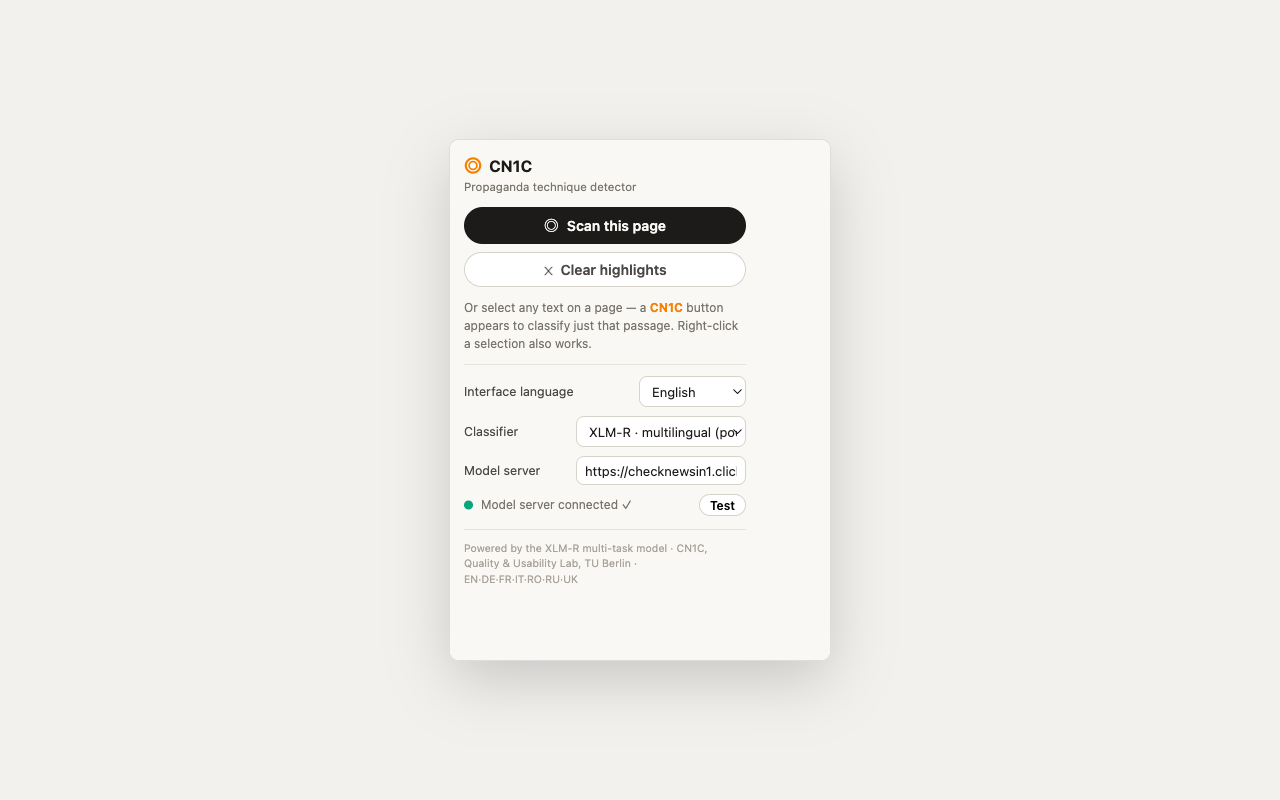
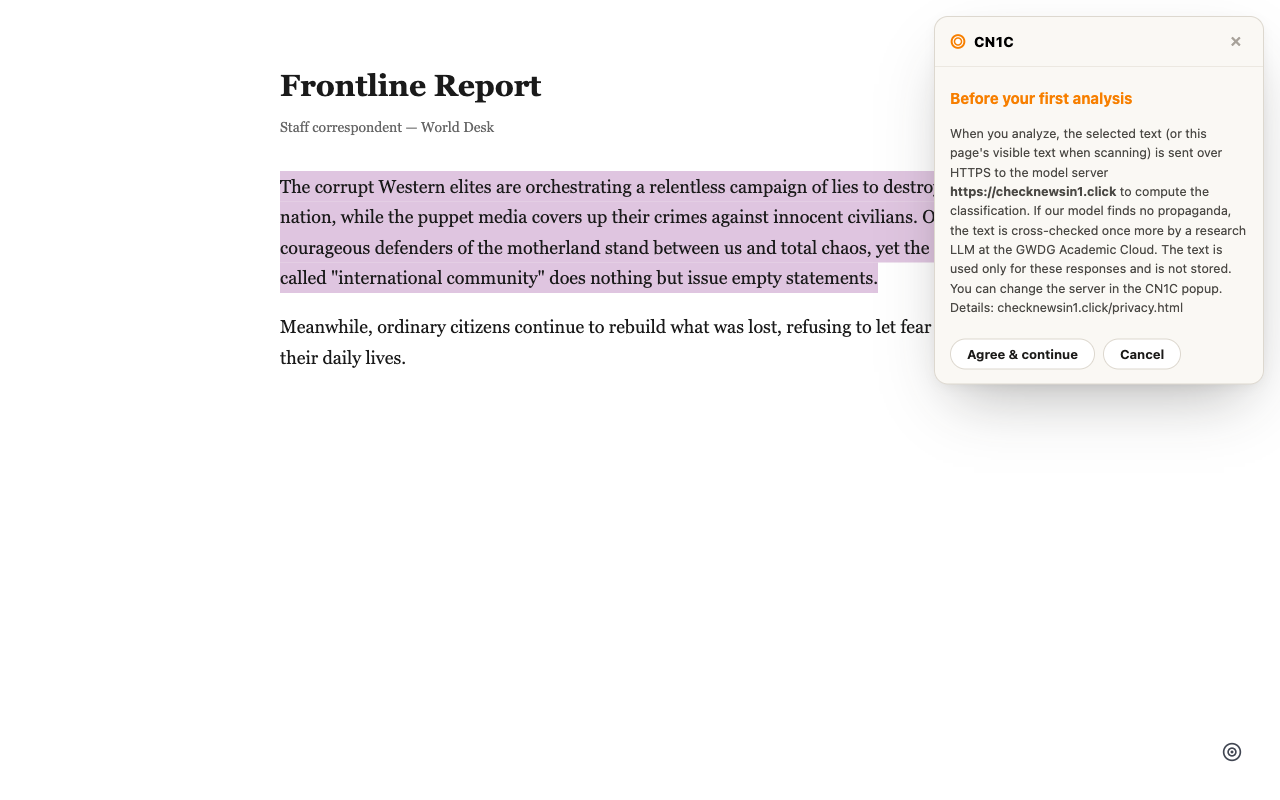
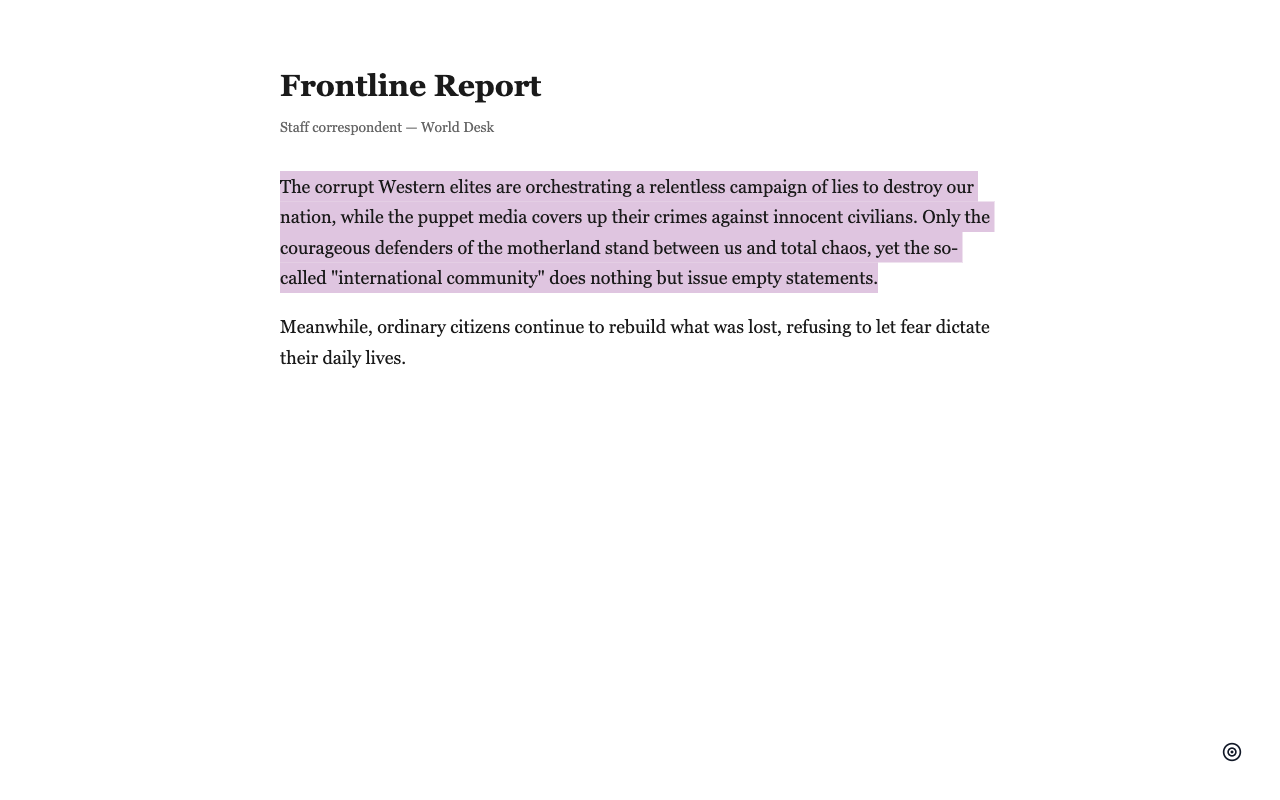
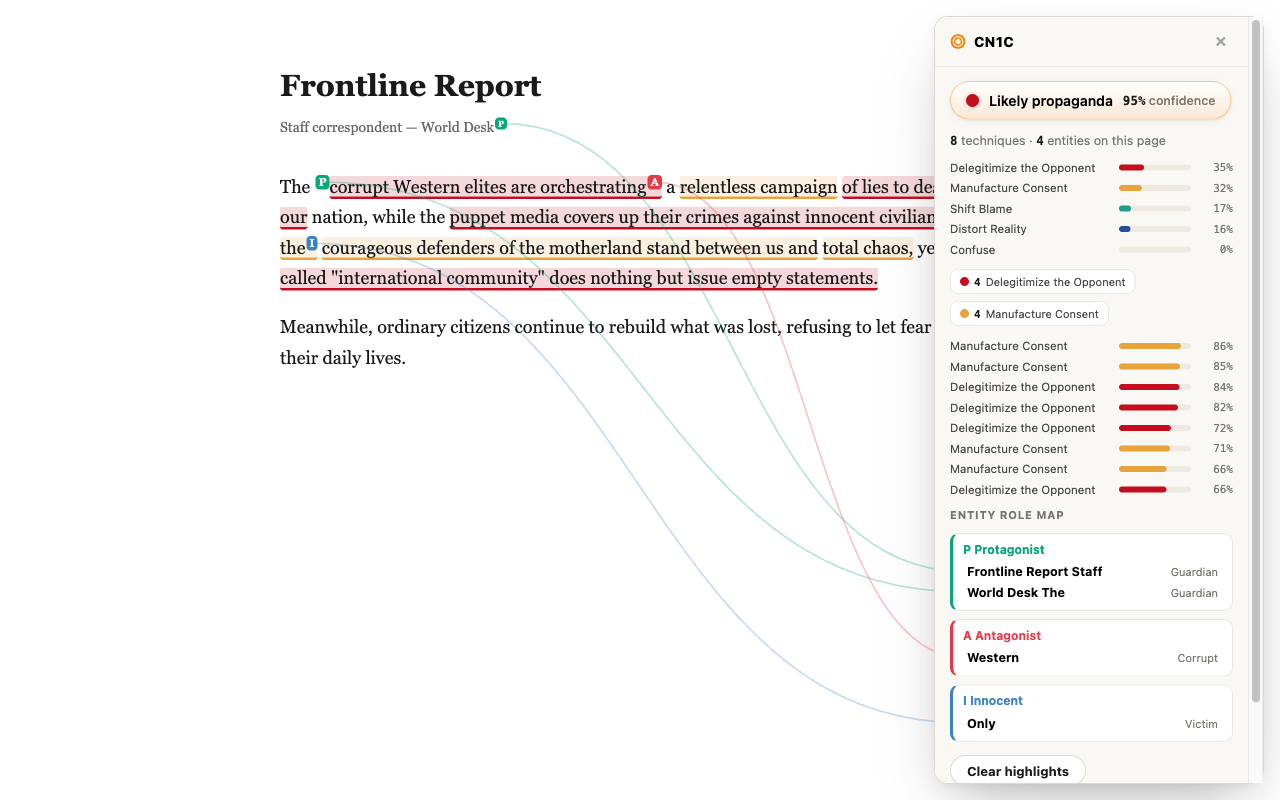
CN1C is coming to Chrome as a browser extension, so you can check text for propaganda right where you find it — a news site, a social feed, anywhere. Select a passage and click the CN1C button, or scan an entire article at once.
See it in action
Privacy
By default, analyzed text is sent to the same CN1C model server this website uses. If the model finds no propaganda, it's cross-checked once more by a research LLM at the GWDG Academic Cloud — see the privacy policy for details. You'll be asked to agree before the first analysis, and you can point the extension at a different server, including one you run yourself.
Participate in Our Research
You are invited to participate in a research study conducted at the Quality and Usability Lab, TU Berlin. This study investigates how users interact with and evaluate a website for identifying propaganda in text. We are particularly interested in how users perceive the system's explanations and whether they help users understand the system's assessments.
What participation involves
Your rights & data handling
- Participation is voluntary. You may stop participating at any time by closing this page without giving a reason.
- The study records your interactions with the tool and your questionnaire responses. No directly identifying personal information will be collected.
- To help ensure data quality, the study stores a randomly generated pseudonymous participant identifier in your browser and submits it together with your responses. This identifier is used to detect duplicate submissions and cannot directly identify you.
- If you would like your submitted data removed after participation, please contact .
- Please note that anonymized responses may be used in academic publications and shared with collaborators.
Research Team
This study is conducted by the Quality and Usability Lab at TU Berlin.
For questions about the study, please contact:
Consent
By clicking I agree and want to participate below, you confirm that you have read and understood this information and voluntarily consent to participate.
No problem!
You can continue using the website without participating in the survey. If you change your mind later, the user survey will remain available.
User Study
Survey summary
Researcher panel for aggregated user-study results. Open this page with ?studySummary=1 to view collected response counts and simple charts.
Introduction
Please answer the following questions about your experience with the propaganda detection tool. The propaganda detection tool is integrated into this questionnaire. There is no need to explore or use the tool before starting the questionnaire. You will be guided to the interaction tasks at the appropriate point and will be asked to evaluate your experience afterward. The questionnaire consists of 5 sections with a total of 28 questions and should take approximately 5-10 minutes to complete. Please answer all questions as carefully and honestly as possible. There are no right or wrong answers; we are interested in your personal experience and opinions.
Section 1 of 5: Background Information
The following questions help us understand the background of participants in this study. Your responses will be used only for research purposes and will be analyzed in aggregate.
Section 2 of 5: News Habits
The following questions ask about your news consumption habits and your experience evaluating information online.
Section 3 of 5: Tool Exploration
The following tasks ask you to interact with the propaganda detection tool and evaluate its outputs. Please analyze at least three different text examples. You are encouraged to use your own texts, but you may also use the provided sample texts if you prefer. Before viewing the tool's prediction, indicate whether you think the text contains propaganda. Please examine the tool's predictions, explanations, and highlighted features carefully, as you will be asked questions about them later in the questionnaire.
Section 4 of 5: Tool Evaluation
The following questions ask about your experience using the tool and your impressions of its features and outputs.
Understanding the Results
Learning and Overall Experience
Future Use
Section 5 of 5: Open Feedback
Finally, we would appreciate any additional feedback about your experience using the tool.
Thank You!
Thank you for participating in our study. Your responses will help us better understand how users interact with propaganda detection tools and will contribute to improving future versions of the system.
We appreciate the time and effort you invested in completing the survey.
If you have any questions about the study, please contact us at .
Returning you to Prolific to complete your submission…
If nothing happens within a few seconds,
click here to
finish on Prolific.